
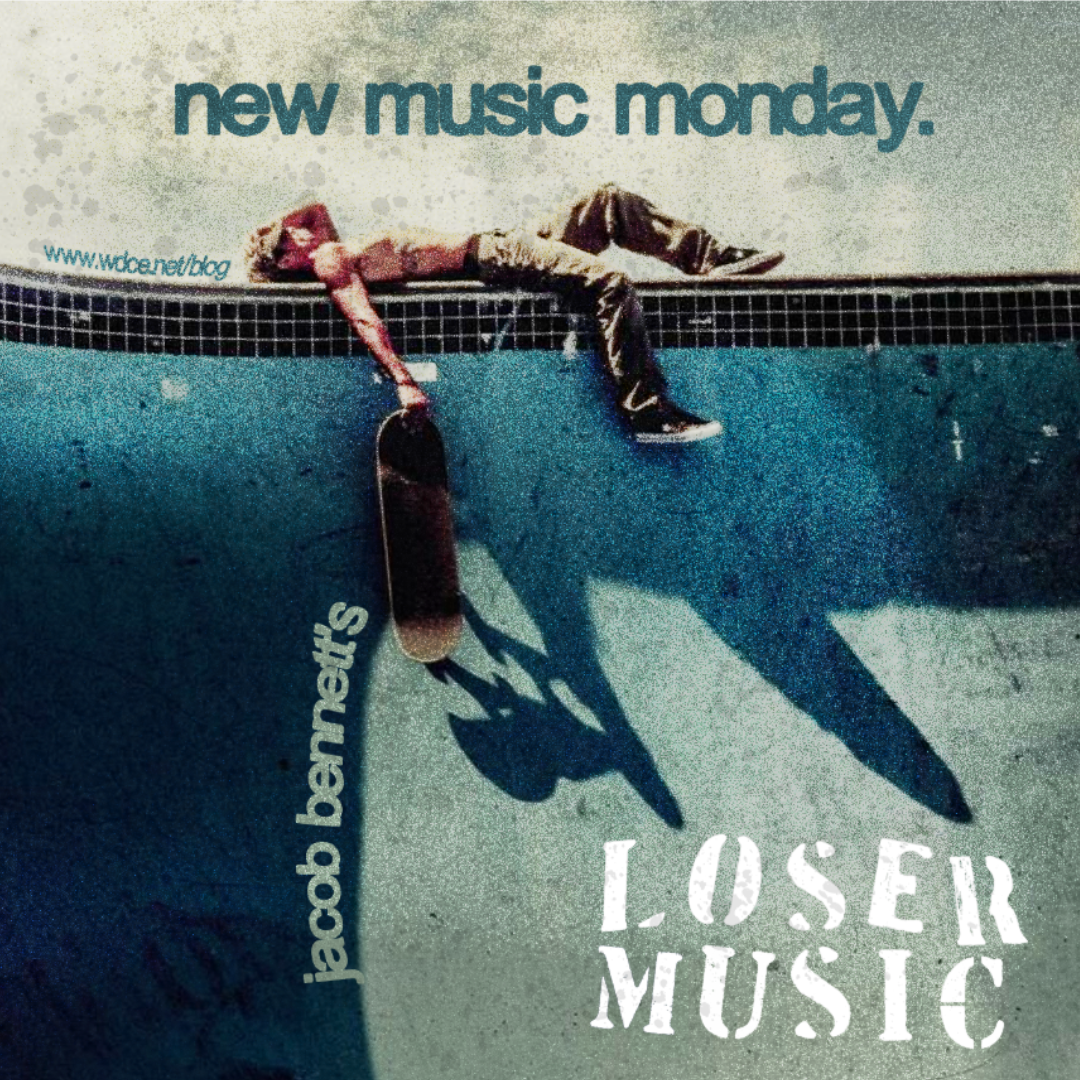
By Jacob Bennett
:: Jacob takes an anthropological looks at so-called “loser music.” He bravely sets foot (ear?) into a subset of music that he surely has no experience with! Read on to find out how Jacob got inside the mind of a “loser” on this socially sober 4/20
:: April 20, 2026
:: “Loser music” is not a genre, nor is it a definitive era of alternative music: it’s a continuous and developing tone of music. It ages alongside the external world, given a new meaning as the attributes of mainstream music shift.
Punk
The “loser” sound was birthed in the grimy, graffitied walls of a ‘90s Manhattan club. CBGB started it all, hosting punk pioneers Bad Brains, Misfits, and most importantly, Ramones. Widely considered to be punk-rock’s establishing band, Ramones fit the “loser” bill perfectly, broadcasting themes of teenage angst, rebellion, and alienation. And alienate themselves they did, with lead vocalist, Joey Ramone claiming that the band formed out of boredom with all other music they’ve heard. Ramones was destined to be a band created for the alternative crowd, adored by the outcast and ignored by the popular.
The up-and-coming band Talking Heads would perform their first ever gig, opening for Ramones at CBGB in June of 1975. In complete contrast to the lyrics and style of Ramones, Talking Heads brought forth an insecurity and nerdiness to the “loser” sound. The track “Don’t Worry About the Government,” from their first album exemplifies this approach. The song takes the voice of a naive U.S. citizen, so immersed in their comfortable job and lifestyle, that they become oblivious to the temporary security that their lifestyle is built upon.
Lines like “I relax along with my loved ones” populate the track, literally not having to worry about the government which protects their happiness, and ignorant to foreign and domestic lives aside from the U.S. middle class. Rebelliousness is drawn from how Talking Heads questions authority, distancing themselves from the infrastructure and pop-culture which complies to the status quo.
Talking Heads has been cited as an influence to many artists, most notably, Radiohead. The band named themselves after the 1986 track “Radio Head,” from the Talking Heads album True Stories — the soundtrack to David Byrn’s own personal film. A film which (fittingly) critiques aspects of American culture and consumerism, while centering on a small town’s “Celebration of Specialness.”
On the topic of film, during his 2014 Oscars acceptance speech, Italian filmmaker Paolo Sorrentino thanked Talking Heads as inspiration for his film The Great Beauty. This film follows a Roman socialite, popular among his peers, yet battling a nihilistic cynicism, struggling to find the beauty behind the facade of superficiality which envelops Rome’s inhabitants. As tangential as it seems, the influence of these early musicians causes ripples of expression beyond music alone, portraying the alienated and ostracized.
Into The ‘90s
This is the decade where “loser” gets a whole new meaning. Instead of explicitly referring to rebellious outsiders who have a bone to pick with the norm, “loser” takes on a much more literal meaning. In the 1993 Beck song, “Loser,” the chorus plainly states, “I’m a loser, baby.” It doesn’t get more blatant than that…
On a more serious note, this track in particular could be seen as the archetypal track of the loser sound, adopting a self-deprecating and highly self-aware viewpoint. Instead of saying “I don’t belong in society,” as ‘70s songs would, this decade says, “I don’t belong in this world.” As morbid as it sounds, these themes of depressive viewpoints and self-hatred are all over ‘90s songs. Radiohead, the king of loser rock, is the most well known arbiter of the genre.
On the Radiohead album, Pablo Honey, released the same year as Beck’s “Loser,” lies an underground, deep-cut track (sarcasm) called “Creep.” This song inspired motifs used by Radiohead for years to come. As many of you are aware, the chorus acts in the same self-deprecatory tone as “Loser,” where Thom Yorke calls himself a creep and a weirdo, ending the chorus with “I don’t belong here.”
It’s a long-running joke that die-hard Radiohead fans hate “Creep,” not because they believe it’s a bad song, but rather they see it as a breach to the inner circle of Radiohead fans because of the song’s popularity — an inner circle of people who relate to the band’s subsequent, more esoteric lyricism. This underlines the foundation of “fandom” culture, and how it’s perceived by outsiders. We’ll address fandom culture later.
A few years later, with OK Computer, Radiohead develops their subject of self-hatred into a deeper subject of self-isolation. On “Subterranean Homesick Alien,” Yorke wishes aliens would take him aboard their ship, and, “show me the world as I’d love to see it —” aliens which see humans as “weird creatures who lock up their spirits.” This song and others on OK Computer highlight the theme of alienation from society, seeing its artificiality as a source of contempt.
This disapproval is further detailed on “Fake Plastic Trees,” speaking on the sedative nature of over-consumerism. Yorke says that we are living in a “fake plastic earth,” and references how artificial products buy “fake plastic love,” and prompt visual alterations like plastic surgery, all working to make society lose its humanity, with the ending chorus saying, “it wears me out.” The sense of isolation is given through the point-of-view of someone depressed by the compliance and obliviousness of modern society towards life-draining artificiality. Where Talking Heads attached this theme to political ignorance on “Don’t Worry About the Government,” Radiohead takes a modern turn, speaking on desensitized consumerism.
Fandom Culture
Any artist can make songs about depression and feelings of ostracisation. Only certain artists have these themes in the forefront of their musical catalog. Though not all, many of these artists’ listeners do so because they feel recognized by the shared feelings of social isolation. More than anyone, adolescents and teenagers struggle with these feelings, whether by having views that conflict against the adult-run society, or by struggling within their own social circles, finding more about themselves and who they fit in with.
All of this to say, adolescents have and always will remain the losers of a culture they don’t fit in with. The ‘70s and ‘80s had a community of “punk teens,” bonding over the shared rejection of convention. The 2000s and 2010s era yields new technology — and there’s no better way to find like-minded people than chatrooms and fan blogs. These websites, among others, such as Reddit and Tumblr, allowed fans of lyrically-alienated artists like Car Seat Headrest or Alex G to find their niche, with users sharing feelings about their mutual infatuation of an artist.
Car Seat Headrest is among the most infamous of “loser” artists. Make note that his music has historically appealed to those who feel like outcasts from their peers. The most common themes in the band’s work are depression, existential isolation, and LGBTQ-centered lyrics, with the lead singer, Will Toledo being gay himself. Such themes deeply resonate with typically-online spaces of like-minded teens.
On the fan-favorite track, “Beach Life-In-Death,” every concept listed above presents itself as plainly as can be. In reference to the sanctity of online communities, Toledo says, “I never came out to my friends. We were all on Skype.” What a statement. The 2011 song is such a product of its era, especially in its portrayal as online spaces functioning as an outlet for real-world insecurities.
Lines of this song most reflective of social isolationism include, “We said we hated humans. We wanted to be humans,” as well as, “My soul yearns for a fugitive from the laws of nature.” These lines especially emphasize the depression and anxiety-induced exclusionary thought towards internally-held suffering. By using the subject of “we,” in relation to his relationship with humanity, Toledo implies how feelings of isolation can be shared by one or more peers undergoing the same identity struggle.
This is how fandom culture grabs hold of many adolescents and young listeners alike. The outlet of shared experiences allows us to be a “fugitive from the laws of nature,” escaping the imposed expectations of older generations by using the internet as a platform to seek consolation when advice from adults is judgemental or misguiding. Car Seat Headrest is just one example of how listeners deemed as anti-social by their peers are able to feel understood by a single musical artist.
The Current Landscape
In the age of the internet, the landscape of musical criticism and online discourse has expanded to new territory. Websites such as Rate Your Music, and Album of the Year emerged, allowing users to numerically rate music releases and view charts of highly rated albums and songs across the decades (with RYM being the most popular). Since ratings are only averaged between those who have listened to the record, small communities of adoring fans could bring an otherwise unknown artist to the top of the charts, instigating a feedback loop of YouTube reviews and online publications, making the release more accessible to the mainstream.
It should come as no surprise that artists such as Geese and Black Midi, and hip-hop artists like Death Grips and JPEGMAFIA top the charts of their respective years. Innovation in sound is what turns the most heads — heads of music-loving internet-users, more welcoming to abstract and unfamiliar sounds. And many times, especially when it comes to abrasive and experimental hip-hop, conversation around releases rarely leaves small internet circles, as this genre in particular can be “physically taxing on the ear.”
I love to hear people’s opinions on Death Grips. Their projects, The Money Store and Exmilitary are among the most esteemed albums of all time on Rate Your Music. They are also some of the noisiest, most aggressive, eclectic, and experimental albums of any rap I’ve heard. The online music-sphere is divided between a small group of obsessed fans, and a much larger group who gave their music a try, and strived to avoid it ever since. It’s from these internet-derived fanbases where a partitioning occurs into a “normal” outgroup, and a “weird” ingroup.
JPEGMAFIA and Danny Brown’s collab album, Scaring The Hoes, sits at #1 on RYM’s 2023 album chart. The album’s title jokingly points out its inevitably mixed appeal. Due to its experimental, manic, and sample-heavy production, the collaborators adopted the chronically-online term “scaring the hoes.” This generally refers to music that would be risky to play around women, as it depicts the guy who’s playing the music as weird and “too different.” Putting aside the questionable sentiment of the phrase, JPEG and Danny Brown make music that is viewed as unpalatable to social settings. You’d feel like quite the loser by playing music that makes your friends wince as they put an airpod in.
We’re All Losers
It’s a passable feeling to be nervous in sharing your abstract music taste. It’s a more strenuous burden to bear if you rely on abstract music as the lone outlet for your repressed emotions. There’s many angles to see this category of “loser” music, but all of them function in the same way: bringing outcasts closer to each other.
The isolated seek comfort in their musical confidants. This is why Radiohead fans or any artist’s fans get upset by songs like “Creep” for reaching into mainstream audiences. It always has been a battle for nicheness. And it’s not out of pretentiousness as many people believe, rather an innate human desire for shared experiences. An Oxford psychology study found that when a shared trait or interest implied being part of a smaller, exclusive group, participants found members of that group more “likeable” than those in larger, more common groups (Launay & Dunbar, 2015). I’m not turning a music blog into a psych paper, so I’ll leave that there.
To round out this final section, it’s important to be aware of the true meaning of “loser” music. This category of music isn’t created with the intention to further isolate, nor to delineate their fanbase as anti-social weirdos. Rather, it’s music that doesn’t comply with mainstream values, often being more experimental and introspective, building community through its uniqueness instead of being pressured to reach broader appeal.
The same individuals most captivated by this category of music are those who live their lives akin to the music they consume. From punk to Radiohead to experimental hip-hop, these listeners build their own communities through their rejection of broader social appeal. In a world of “fake plastic trees,” those who stand out in their differences are those most aware of their own identity and what they value in life.
::

Music Director
Jacob knows his way around a four-wheeler… and a Music Monday. Jacob found and tamed his first ATV in the wild western pastures of Kansas. This guy can handle a live machine, so it’s safe to say he knows a good rap album when he hears one. Ride on, Jacob!
Do YOU want to write a blog? Yes, YOU!! If you HEAR something… WRITE something! Send submissions to wdcemd@gmail.com !!

Leave a Reply